Patent Translations Inc. · Notes
A new paradigm for artificial intelligence in translation
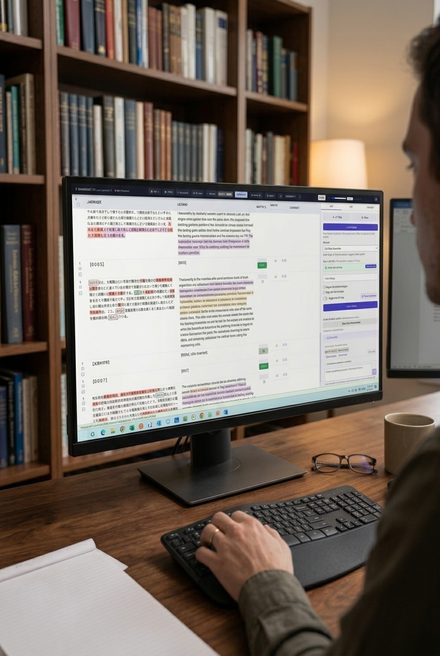
As the first article in this series describes, using AI as a translator introduces quiet failure, autoregressive bias, smoothing, and a tendency toward agreeableness that progressively degrades output. These are not bugs to be fixed by the next model release; they follow from how large language models work. But, far from having reached an unavoidable endpoint, the most important role for LLMs in patent translation has only just started. Instead of using AI to generate translations and hoping it gets it right, the technology can be pointed in the opposite direction and used as a tool that helps humans find and correct translation errors with unprecedented speed and accuracy. The new paradigm uses artificial intelligence to surface errors rather than paper them over.
The best way to a strongly defensible translation has long been understood by experienced litigation attorneys and legal translation providers. It is a combination of hard work, expertise, and billable hours. Rather than just asking an individual translator to make their best effort, the process requires supervisory support within the framework of a translation methodology suitable for legal evidence, as well as review and two-way questioning with other translators, technical subject matter experts, attorneys, and proofreaders. This is, of course, expensive. Moreover, similarly to the case of an expert witness, when a law firm interacts with the translator or agency in a litigation matter, skilled attorney supervision is necessary so that this does not morph into biasing of the translator, who must be able to certify the translation on the basis of their own independent judgment.
This note describes PatentCAT 2.0, a second-generation computer-assisted translation environment built only for patents, which was designed and tested in-house at Patent Translations Inc., by the translators who use it. While not yet available to the public, the functions and methodologies described here will be of interest to attorneys and translators, even without the software. In fact, some can be implemented today using a simple text interface with a frontier LLM.
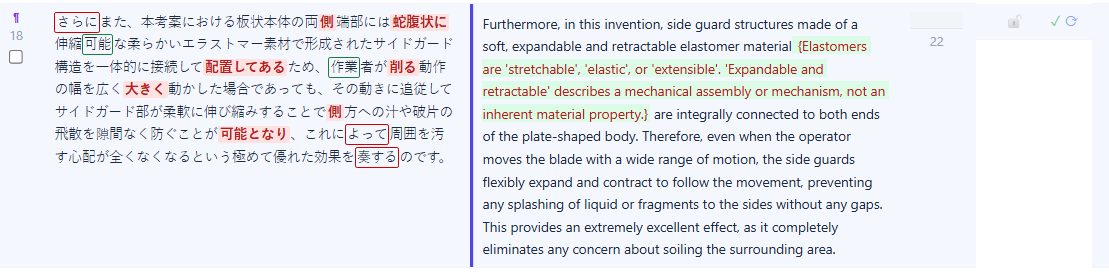
The shape of the software, as seen above, will be familiar to users of conventional CAT products such as Trados or memoQ, but the system works on very different principles. PatentCAT combines highly structured AI analysis with complex hard-coded error reporting and guardrails. When a document is loaded, a series of specialized analysis requests are used to map the content of the entire document. Every word that is used more than once is tracked to allow enforcement of consistent usage (terminological consistency). Likewise, recurring semantic (logical) and structural patterns are assigned to families, to ensure that the translated specification always reads on the translated claims. Antecedent basis and plural/singular usage are also analyzed before any translation begins. With these preconditions, the program watches a human translator as they translate and applies their judgment calls to untranslated text as the work progresses. Alternatively, PatentCAT can start from any existing translation, including machine translations that may reflect a client's preferred terminology and boilerplate. This second mode will also allow attorneys to quickly analyze the reliability of any translation they have in hand.
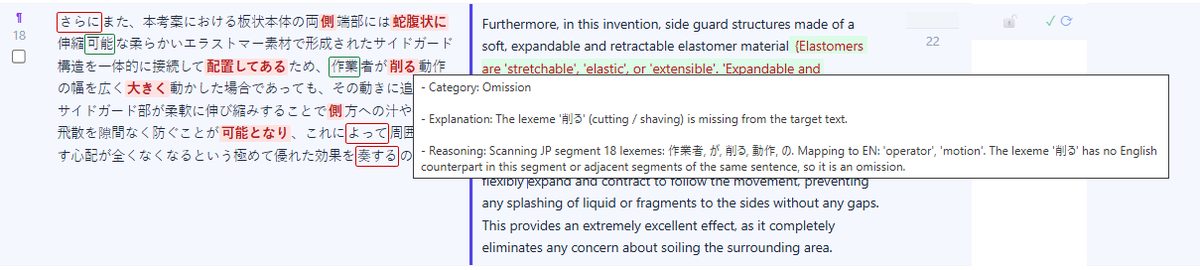
In addition to omission, inconsistency, inaccuracy, and technical coherence, the LLM flags ambiguities, allowing the translator to evaluate whether the scope of Japanese disclosure is faithfully reflected. It is also possible to assess the translation for adherence to formal methodologies, such as conservation of lexemes, house style rules, and glossaries.
The program uses fifteen different prompts to surface potential problems from multiple perspectives. Each of these prompts relies on its own knowledge base and incorporates a specific persona so as to overcome the problems of autoregressive bias, assumption, drift, smoothing, and gullibility. The prompts are run in a specific sequence, requiring human decisions each time that the LLM feedback is displayed. The whole-document map that was built before translation starts allows a single decision to be propagated to every instance of that same issue, massively increasing speed and consistency (decision consistency). What is more, these decisions are locked in by guardrails so that subsequent editing in another location within the document cannot reintroduce an error or inconsistency that has already been decided on.
Structurally similar Japanese sentences whose English has diverged are flagged in real time, and when an edit on one row creates an inconsistency forty pages away, a warning flashes in real time to let the translator know (structural consistency). No human reviewer can reliably hold a 60-page specification in working memory; now they don't have to.
A progressive gating system prevents work from going forward until the translator makes a determination on every issue raised, eliminating the risk of glossing due to cognitive overload, and ensuring that deliverables have been reviewed against all configured tests. Each decision and each revised version of the translation can optionally be tracked, producing a permanent timestamped record of every determination made.
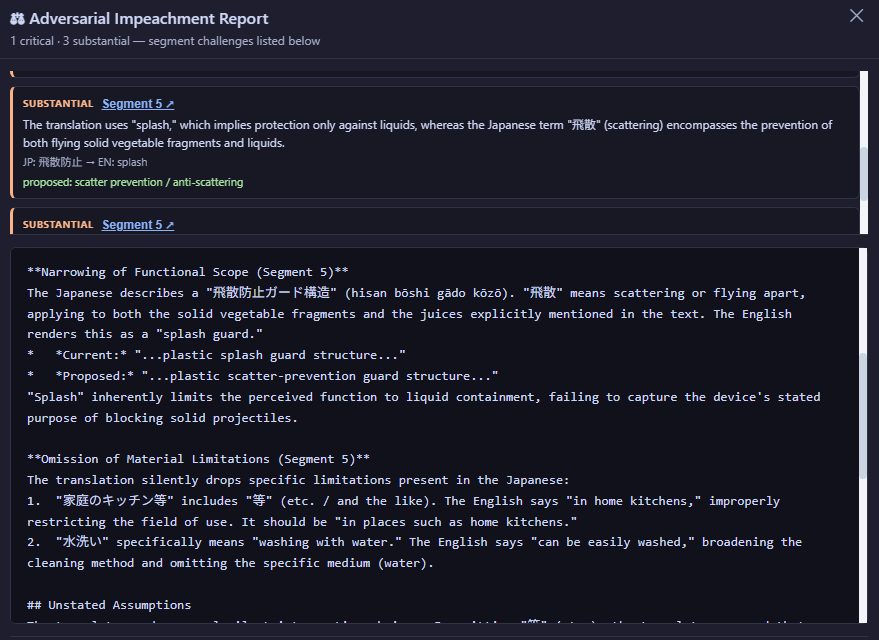
When a sentence is particularly important, complicated, or ambiguous, the translator can call for a dedicated adversarial review of that segment alone. This prompt is not the translator's friend. It always finds fault and never pulls punches, which is a service that is almost impossible to buy in the real world.
It is also possible to commission multiple versions of the same translation by LLM "translators" with different backgrounds and translation philosophies. The program even allows you to see them argue among themselves about why their translations are right. The models have no stake in the outcome and no knowledge of which reading would help any party. They will argue any side of a question with equal vigor. In minutes, the translator gets a range of perspectives without the risk of an interested party appearing to instruct or coach the translator. This virtual "team of rivals" approach may eventually become standard in translations for patent litigation. If it does, translations that have not been subjected to this level of scrutiny will be vulnerable to impeachment by those that have.
PatentCAT 2.0 is designed to run either on a locally hosted LLM, providing air-gapped confidentiality so client data never leaves the desktop, or on frontier models through secure APIs (no training, no disclosure).
We built PatentCAT to improve quality, based on lessons from decades of translating patents for prosecution and litigation, which taught us where translations fail and the best ways to catch those failures. The law firms served by Patent Translations Inc. already benefit from the increase in quality assurance. What is surprising is that these levels of analysis and enforcement increase not only accuracy but also throughput. Good translations have always involved similar levels of review and probing, but most of the work has been done in the heads of the translators and reviewers. PatentCAT shifts the cognitive load on the translator away from short-term memory and clerical tasks, allowing them to spend almost all of their energy on high-value judgments, ensuring higher volumes in less time. The combined effects significantly improve throughput over conventional workflows. We have also been able to pass on these gains to our clients in the form of competitive pricing.
None of this removes the translator from the work. Every decision in a PatentCAT document is made by a person who can be asked why they made it. The machine contributes what it does best: tireless, unsentimental, repetitive challenge and tracking, applied to every word and, simultaneously, to the entire content of the document.
You do not need our software to begin. The next article in this series sets out the principles for working prompts and LLM parameter settings that you can use today with any frontier model to surface omissions, inconsistencies, and quiet inaccuracies in a translation you already have in hand.